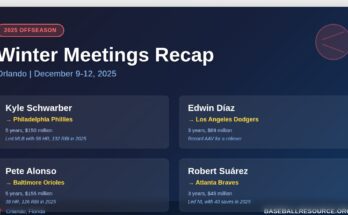
As we ring in the New Year and January begins, the 2025-26 MLB free agent market remains surprisingly active. While several major deals have already been completed, including Pete Alonso’s move to Baltimore and Dylan Cease’s seven-year agreement with Toronto, some of baseball’s biggest names are still searching for their next homes. With spring training just weeks away, let’s examine the top remaining free agents and where they might land.
The Elite Tier: Impact Players Who Will Shape Contenders
Kyle Tucker, OF – The Top Prize Still Available
At 28 years old, Kyle Tucker remains the crown jewel of this free agent class. The four-time All-Star is coming off another solid season where he hit .266/.377/.464 with 22 home runs and 25 stolen bases despite dealing with injuries that have plagued his last two campaigns. Tucker suffered a hand fracture in 2025 and a shin fracture in 2024, raising some durability concerns despite his track record of playing 505 out of 546 possible games from 2020-2023.
What makes Tucker special is his five-tool profile. He’s a patient hitter who draws walks, steals bases efficiently, and provides Gold Glove-caliber defense in right field. While he doesn’t lead the league in any single category, his consistency across all facets of the game makes him valuable to any contender.
The Toronto Blue Jays have emerged as the favorite to land Tucker after he visited their spring training facility in Dunedin, conveniently located near his Tampa hometown. The Blue Jays are in win-now mode after reaching the World Series in 2025 and have payroll flexibility with several big contracts coming off the books after 2026. The New York Mets and Los Angeles Dodgers also loom as possibilities, given their financial resources and need for outfield help.
Contract projections range from 10-12 years at $350-400 million, though his recent injury history and lack of elite performance in any single area may temper expectations compared to recent mega-deals for Juan Soto and Shohei Ohtani.
Alex Bregman, 3B – The Proven Winner
Alex Bregman finds himself back on the market after opting out of the final two years of his three-year, $120 million deal with the Boston Red Sox. Despite missing 43 games with a quad injury, the 31-year-old third baseman showed no ill effects from last winter’s slow market, posting a .273/.360/.462 line with 18 home runs and earning his first All-Star selection since 2019.
What sets Bregman apart is his championship pedigree and consistency. He’s never finished worse than 15 percent above league average as a hitter throughout his career, and he joined the elite “90-90 club” in 2025 with a 90 percent in-zone contact rate and 90 mph average exit velocity. His defense at third base remains Gold Glove caliber, though questions persist about how his pull-heavy approach would translate to different ballparks.
The Blue Jays, Arizona Diamondbacks, Chicago Cubs, and Red Sox have all shown interest in Bregman. A reunion with Boston makes sense given his strong relationship with manager Alex Cora and the team’s contention window, though Toronto’s aggressive pursuit could complicate matters. The Diamondbacks have emerged as one of the most aggressive suitors, potentially looking to upgrade over current options.
Expected contract: Five to six years in the $150-180 million range, improving on last year’s rushed three-year deal.
Bo Bichette, SS/2B – The Hit Machine
Bo Bichette’s free agency has been one of the most intriguing storylines of the offseason. After spending nearly a decade in the Blue Jays organization and reaching the World Series with Toronto in 2025, the two-time All-Star remains unsigned despite his strong bounce-back campaign.
Bichette hit .311/.357/.483 with 18 home runs and 94 RBI in 139 games, tying for second-most hits in baseball with 181 and second-best batting average. His 44 doubles also ranked second in the majors. However, defensive metrics remain concerning, as he tied for last among shortstops in outs above average at minus-13.
The game-changer for Bichette’s market came when his camp announced he’s willing to move to second base, where his bat profiles better and his defense would be less of a liability. This flexibility opens up opportunities with teams like the Red Sox, who have Trevor Story at shortstop. The Blue Jays remain a possibility for a reunion, potentially sliding him to second base alongside Andrés Giménez at short.
Bichette’s future appears tied to Bregman’s decision, as both the Blue Jays and Red Sox are pursuing both players. At just 27 years old, Bichette represents the youngest impact bat available and could command a five-year deal worth $130-150 million, especially after recent contracts for Kyle Schwarber ($150M) and Pete Alonso ($155M) reset the market for offensive-minded players.
The Pitching Market: Frontline Starters Still Seeking Homes
Framber Valdez, LHP – The Workhorse Lefty
Framber Valdez stands as the top left-handed starter available after declining the qualifying offer from Houston. The 32-year-old two-time All-Star posted a 3.66 ERA across 192 innings in 31 starts during 2025, recording 187 strikeouts and tossing two complete games. His 20 quality starts tied for seventh-most in the majors.
Valdez’s game is unique in today’s strikeout-driven baseball landscape. He’s a contact manager who generates elite ground balls with his three-pitch mix of sinker, curveball, and changeup. While his average exit velocity surrendered ranks near the bottom of the league, his ability to coax weak contact on the ground makes him effective when paired with strong infield defense.
The veteran southpaw has made at least 28 starts and posted a sub-3.70 ERA in each of the last four seasons, averaging 192 innings over that span. His durability and postseason experience (two World Series rings with Houston) add to his value.
The New York Mets, Chicago Cubs, and Baltimore Orioles have all been connected to Valdez. The Cubs particularly need a top-of-the-rotation arm they can trust in October, while the Orioles could use a veteran presence after acquiring Pete Alonso. Contract expectations range from five to seven years at $160-189 million, potentially matching the framework of Max Fried’s eight-year, $218 million deal with the Yankees.
Ranger Suárez, LHP – The Postseason Ace
Ranger Suárez declined the qualifying offer from Philadelphia after posting a career-best 3.20 ERA across 157.1 innings in 26 starts. The 30-year-old southpaw has earned his reputation as “the cooler” from agent Scott Boras for his calm demeanor in high-pressure situations.
Suárez’s postseason resume speaks volumes: a 1.48 ERA across 42.2 career October innings. He’s thrived both as a starter and reliever, bringing versatility that few pitchers can match. His average fastball velocity dropped to 91.3 mph in 2025, raising some durability questions, but his four-pitch arsenal and ability to command the strike zone offset velocity concerns.
Back injuries have plagued Suárez in three of the last four seasons, which could impact his contract length. Both the Cubs and Orioles make sense as landing spots, offering the combination of contention window and rotation need. The Diamondbacks have also shown interest as they look to bolster their pitching staff.
Expected deal: Four to five years, $100-125 million, which would place him just behind Valdez in the starting pitcher hierarchy.
Cody Bellinger, OF/1B – The Versatile Veteran
Cody Bellinger’s reunion with the New York Yankees seemed inevitable after his outstanding 2025 season, yet here we are in January with the former MVP still unsigned. Bellinger hit .272/.334/.480 with 29 home runs while providing Gold Glove-caliber defense across multiple positions.
What makes Bellinger valuable is his reinvention as a contact hitter. He struck out at a career-low rate in 2025, ranking alongside elite contact hitters like José Altuve. His in-zone contact rate improved dramatically, suggesting sustainable improvements rather than a fluke season.
The Yankees remain the favorites, with Aaron Judge reportedly advocating for a reunion. Yankee Stadium’s short porch in right field perfectly suits Bellinger’s left-handed pull power. However, the Giants have also shown strong interest, seeking their first 25-plus home run outfielder since 2014.
Contract projection: Six years, $140-150 million, rewarding his versatility and resurgence while accounting for his age (30 on Opening Day).
International Additions Still Available
Kazuma Okamoto, 1B/OF (NPB)
Japanese slugger Kazuma Okamoto was posted by his NPB club on November 21 and has until January 4 to sign with an MLB team. The 30-year-old brings intriguing power potential to a team looking for middle-of-the-order thump.
Kona Takahashi, RHP (NPB)
Right-hander Kona Takahashi also faces the January 4 deadline. The 28-year-old posted a 3.04 ERA with 88 strikeouts across 148 innings in 2024, showing solid control with his 1.230 WHIP.
Notable Mid-Tier Options
Luis Arráez, 1B – The Contact Artist
Three-time batting champion Luis Arráez remains available despite hitting .292 with the second-most hits in baseball (181). The 28-year-old had the lowest strikeout percentage in the majors at just 3.1 percent but also posted concerning defensive metrics (minus-7 outs above average at first base) and rarely walks (5 percent walk rate).
J.T. Realmuto, C
The veteran catcher accumulated 4.0 WAR across 2024-25 and remains one of the better two-way catchers available. At 35 years old, Realmuto provides championship experience and leadership behind the plate.
Catchers: Victor Caratini and Others
Victor Caratini (2.7 WAR) leads a group of veteran backstops including Jonah Heim, Mitch Garver, and Gary Sánchez. Several quality catchers have already signed, including Danny Jansen (Texas Rangers) and James McCann (Arizona), but options remain for teams seeking catching depth.
Why the Slow Market?
This offseason has been notably slower than recent years, when generational talents like Juan Soto and Shohei Ohtani signed mega-deals by mid-December. Several factors contribute to the delayed timeline:
Draft Pick Compensation: Thirteen players received qualifying offers, and those who declined (Tucker, Valdez, Suárez, Bregman, Bichette, Gallen) carry draft pick penalties that may cause teams to hesitate.
Interconnected Markets: The decisions of Tucker, Bregman, and Bichette are linked, as teams pursuing multiple players wait to see where the dominoes fall. The Blue Jays’ involvement with multiple top free agents has created a bottleneck.
Financial Caution: After several years of unprecedented spending, some teams appear more cautious about long-term commitments to players with injury concerns or aging curves.
Historical Precedent: Last offseason saw Pete Alonso and Alex Bregman wait until February to sign, suggesting teams feel no urgency with spring training still weeks away.
What to Watch For
As we move deeper into January, several storylines will shape the remainder of free agency:
- Tucker’s Decision: Where the top free agent lands will trigger a cascade of signings. If the Blue Jays land Tucker, they’re likely out on Bregman and potentially Bichette as well.
- Pitching Dominoes: Once Valdez signs, expect Suárez and other starters to follow quickly as teams reassess their rotation needs.
- The Mets’ Moves: New York has money to spend and holes to fill after trading away pieces and losing free agents. Their decisions could reshape multiple position groups.
- The Orioles’ Next Move: After landing Alonso, Baltimore has shown willingness to spend. A starting pitcher addition seems logical.
- International Signings: The January 4 deadline for Okamoto and Takahashi could provide clarity for teams still seeking power bats or rotation depth.
The Bottom Line
While this free agent class lacks the generational superstars of recent years, it offers quality depth across multiple positions. Kyle Tucker, Alex Bregman, and Bo Bichette provide impact bats who can change a lineup’s complexion, while Framber Valdez and Ranger Suárez offer frontline starting pitching for teams ready to contend.
The slow pace of signings doesn’t diminish the talent available. History shows that the best deals often come in late January and February as teams grow desperate to fill needs before pitchers and catchers report. For teams still in the market, patience may be rewarded with value contracts for proven performers.
As spring training approaches, expect the pace to accelerate. Teams have needs, players want homes, and the pressure to complete rosters will intensify. The next few weeks promise to deliver the fireworks this offseason has largely lacked so far.
The 2026 season promises competitive balance and drama, and where these remaining free agents land could determine which teams contend for championships and which fall short. Stay tuned as the hot stove finally starts to heat up.