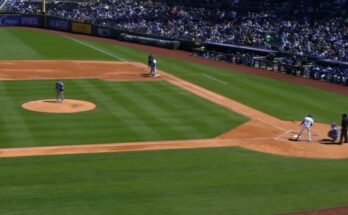
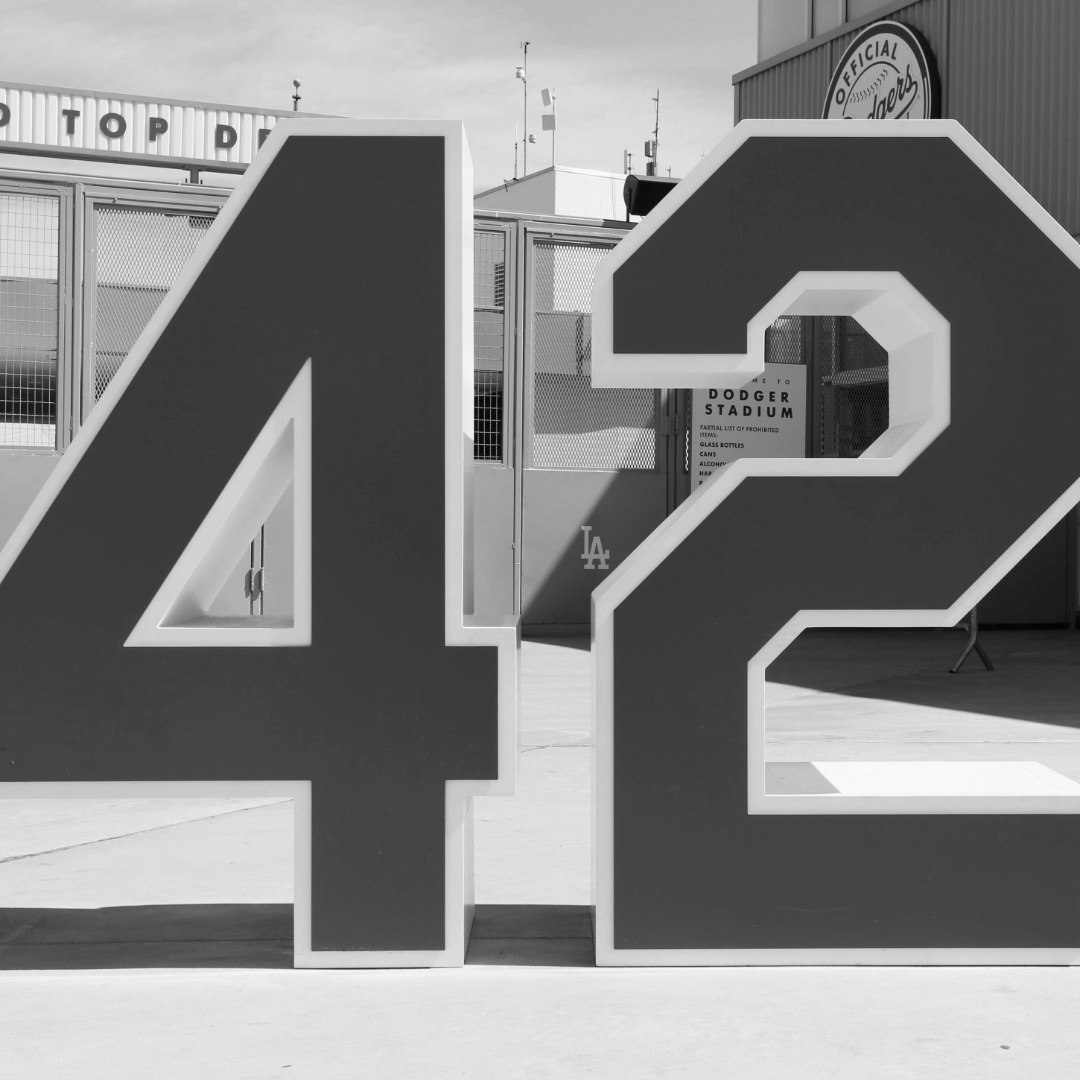
Every April 15, something unique happens across Major League Baseball. Players from all 30 teams — rivals in every other sense — pull on jerseys bearing the same number. Number 42. It is the only uniform number retired across the entire league, a permanent tribute to a man whose impact on the game, and on the nation, cannot be measured in statistics alone.
Today is Jackie Robinson Day, and this year marks the 79th anniversary of the most consequential debut in the history of American professional sports.
From Cairo to Ebbets Field
Jack Roosevelt Robinson was born on January 31, 1919, in Cairo, Georgia — the son of a sharecropper and the grandson of formerly enslaved people. When Jackie was still an infant, his father abandoned the family, and his mother Mallie packed up her five children and moved west to Pasadena, California, working tirelessly as a domestic worker to keep the family afloat.
From his earliest years, Robinson understood that he would have to outwork everyone just to be given a chance. That drive showed early. At John Muir High School, he excelled across every sport he tried, and by the time he reached UCLA, he became the first athlete in university history to letter in four sports — football, basketball, track, and baseball — in a single year.
His path to the major leagues, however, would not be a straight line. After graduating, Robinson was drafted into the Army during World War II, where he served as a second lieutenant. Even in uniform, Robinson faced the ugliness of segregation. In 1944, he refused to move to the back of a segregated military bus at Fort Hood, Texas. He was arrested, court-martialed — and ultimately acquitted, receiving an honorable discharge. It was a preview of the courage that would define his entire life.
Following his discharge, Robinson joined the Kansas City Monarchs of the Negro Leagues, where his talent attracted the attention of Branch Rickey, president and general manager of the Brooklyn Dodgers.
The Great Experiment
In August 1945, Rickey met with Robinson and laid out his vision: he wanted Jackie to be the man who broke baseball’s color barrier. But Rickey was blunt about the terms. Robinson would need to absorb the hatred, the slurs, the physical intimidation — without reacting. Not because he was weak, but because any reaction would be used to dismantle the entire endeavor.
Robinson signed with the Dodgers’ minor league affiliate, the Montreal Royals, in October 1945, and made such an impression there that on April 15, 1947, he trotted out to first base at Ebbets Field in Brooklyn, becoming the first Black player to play Major League Baseball in the modern era.
The welcome was anything but warm.
Before the season even began, some of his own teammates circulated a petition against him playing. On the road, opposing players and managers directed relentless abuse at him. Philadelphia Phillies manager Ben Chapman infamously directed his entire bench to hurl racial taunts at Robinson during a game, in front of a packed stadium. Robinson dug in, refused to react, and just kept playing ball.
He played it extraordinarily well.
An Unmatched Career
Despite being subjected to threats, physical spikings on the basepaths, and social isolation that his white teammates never had to face, Robinson produced one of the most decorated careers in Dodgers history.
In 1947, his first season, Robinson won the inaugural Rookie of the Year Award — the first such honor given by the Baseball Writers’ Association of America. Two years later, in 1949, he took the National League batting title with a .342 average, drove in 124 runs, stole a league-leading 37 bases, and was named the National League’s Most Valuable Player — the first Black player to receive that honor.
Over his 10-year career with Brooklyn, Robinson posted a .311 career batting average, hit 137 home runs, drove in 734 runs, and stole 197 bases. He was a six-time All-Star, appeared in six World Series, and helped deliver Brooklyn’s first and only World Series championship in 1955, when the Dodgers beat the New York Yankees.
He was inducted into the Baseball Hall of Fame in 1962, in his first year of eligibility.
The statistics tell part of the story. But the context makes them staggering. Robinson achieved all of this while carrying the weight of an entire movement on his shoulders — under constant scrutiny, constant hostility, and constant pressure not just to succeed, but to succeed perfectly, for the sake of everyone who would come after him.
Beyond the Diamond
When Robinson retired after the 1956 season, many assumed he would step away from public life. Instead, he stepped into the fight more directly than ever.
Robinson became a prominent voice in the civil rights movement, working alongside Dr. Martin Luther King Jr. at rallies, marches, and demonstrations. He spoke at the March on Washington in 1963. He chaired the NAACP’s Freedom Fund Drive and later joined the organization’s board of directors. He co-founded the Freedom National Bank in Harlem in 1964 — a Black-owned financial institution designed specifically to provide capital to communities that mainstream banks routinely ignored. In 1970, he established the Jackie Robinson Construction Company to build housing for low-income families.
Dr. King recognized what Robinson represented well beyond the sport. “Jackie Robinson made my success possible,” King said. “Without him, I would never have been able to do what I did.” King called Robinson a “sit-inner before the sit-ins, a freedom rider before the Freedom Rides” — someone who had waged the fight for equality years before the broader movement found its footing.
Robinson was also the first Black television analyst in Major League Baseball, and the first Black vice president of a major American corporation, Chock Full O’Nuts.
His life stood as living proof that the demand for equality was not a political abstraction. It was something a man in a baseball uniform could demonstrate to an entire country, game by game, season by season.
How the Legacy Is Honored Today
The tradition of honoring Robinson on April 15 began in 2004, when Commissioner Bud Selig officially declared the date Jackie Robinson Day across all of Major League Baseball. In 1997, on the 50th anniversary of his debut, MLB had already taken the unprecedented step of retiring number 42 across every team in the league — the only number ever retired league-wide in any professional American sport.
In 2009, the league took the tribute further: for the first time, every player on every team — not just a handful of volunteers — wore number 42 on Jackie Robinson Day. That tradition continues today, with all uniformed personnel league-wide donning the number, along with special “42” cap patches and royal blue socks.
This year, for the 79th anniversary, each of MLB’s 30 clubs is holding events in partnership with local organizations focused on increasing Black participation in baseball. The Los Angeles Dodgers are hosting a ceremony at the Jackie Robinson statue in Centerfield Plaza, joined by the New York Mets, the Jackie Robinson Foundation, and Robinson’s granddaughters. The Athletics are welcoming a Jackie Robinson Foundation scholar to throw out the ceremonial first pitch. The Braves are bringing children from the Jackie Robinson Boys & Girls Club to Truist Park. Teams across the country are using the day to connect Robinson’s legacy to the next generation of players and fans.
The Continuing Mission
Jackie Robinson died on October 24, 1972, at the age of 53, following a long battle with diabetes. He had gone partially blind. His oldest son, Jack Jr., had died the previous year. He was not yet old, and the world had not yet given him everything he’d earned.
But the foundation he built did not die with him. Rachel Robinson, now 102 years old, continues to honor his legacy. The Jackie Robinson Foundation has provided scholarships and support services to more than 1,700 students from 45 states. The Freedom National Bank model he envisioned endures in the spirit of community banking institutions across the country. The players who followed him — Willie Mays, Hank Aaron, Bob Gibson, Ernie Banks, and generations more — were made possible in part because Robinson absorbed what he did in 1947 and refused to quit.
Robinson once said: “A life is not important except in the impact it has on other lives.”
By that measure, few lives in American history have been more important.
What Number 42 Means Today
When you watch tonight’s games and see every player wearing the same number, it is worth pausing to remember what that number represents. It is not just a tribute to a great baseball player. It is an acknowledgment that baseball — and the country — were built on injustice, and that one man, with extraordinary courage and talent, refused to accept it.
He did not do it alone. Branch Rickey took a calculated risk and chose him. Rachel Robinson stood beside him. Teammates like Pee Wee Reese, who once put his arm around Robinson on the field in front of a hostile crowd, chose solidarity over comfort. Fans in cities across the country, particularly Black Americans who packed ballparks to see Robinson play, made clear that the nation was ready for what Robinson represented.
But Robinson was the one who had to walk onto the field.
Seventy-nine years later, every player in the major leagues walks onto the field wearing his number. That is not a small thing. It is one of the most powerful gestures in American sports — a league-wide acknowledgment, renewed every year, that what Jackie Robinson did changed everything.
Happy Jackie Robinson Day.